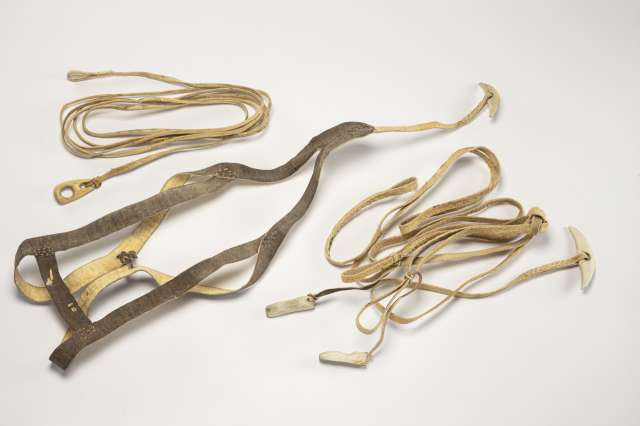
Gear for bow hunting
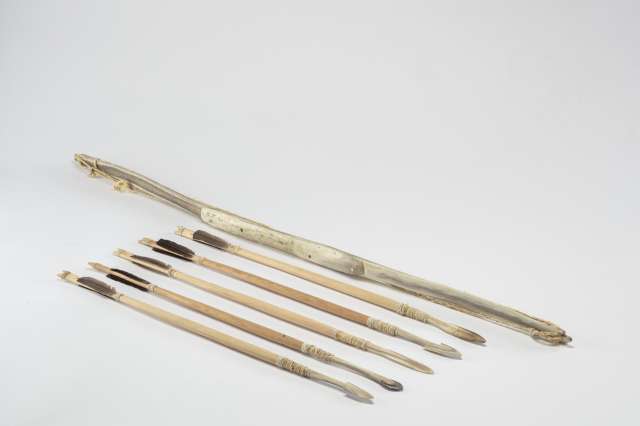
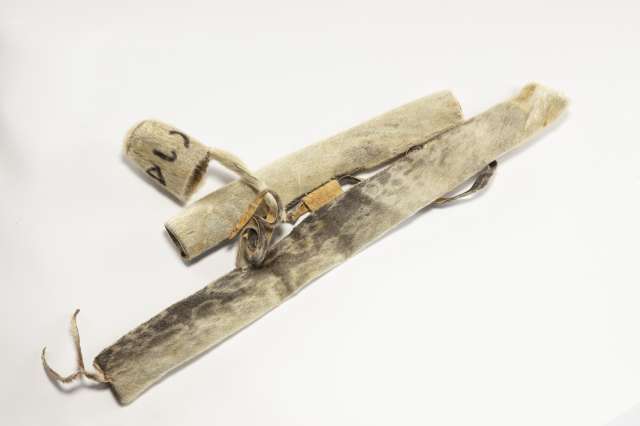
The bow-hunting gear includes a quiver for arrows, a case for a bow, five arrows, and a bow. This kit was used to hunt large land mammals, like bears, and also smaller game animals, like birds.
Bow
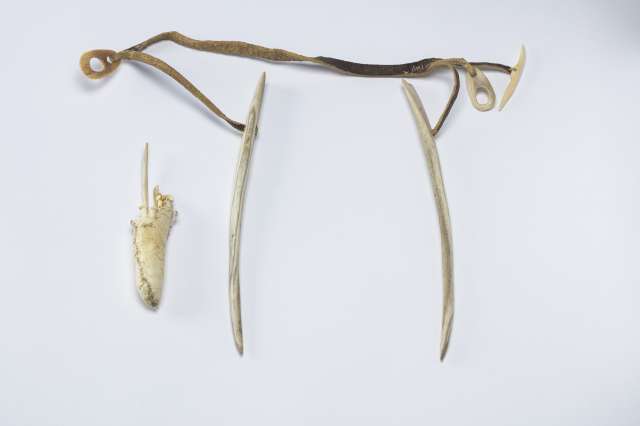
The bow (pisiksi) was made of three pieces of caribou antler held together by metal nails. Before Iglulingmiut had access to metal, they would use walrus whiskers or threads of caribou sinew to tie together the pieces of caribou antler. On the side held by the archer, several braids of caribou sinew made the bow sturdier. On the other side, a braided bowstring, named a nuqqavinga, joined the two ends of the bow. The arrow (qarjuq) was shot by placing its shaft end in the bowstring.
Arrows
Here, the arrows are wooden, but they were more often made of bone or caribou antler because access to wood was limited in the Igloolik region. The arrowhead (naqqu) was made of caribou antler or metal and sharpened in a simple manner. It served to pierce and wound the animal. Serrated arrowheads were designed to go deeper into the flesh whenever the animal moved. The arrow's feathers (sulugvautik, singular noun) would help it fly through the air along a precise trajectory.
Quiver
The arrows were kept in a caribou-skin quiver, which bears the syllabic inscription piugatu — the name of the person who made it: Noah Piugattuq. The quiver (qarjuup puunga) is tied by a leather strap to the bow case (pisikiup puunga) made of ringed-seal skin. The case is slightly shorter than the bow itself, so that the hunter could grab hold of the bow more readily.
Nowadays, hunters tend to prefer hunting with a rifle, which they can use to shoot over long distances. It is also easier to obtain a firearm and ammunition than to make a bow and arrow from resources available on the land.